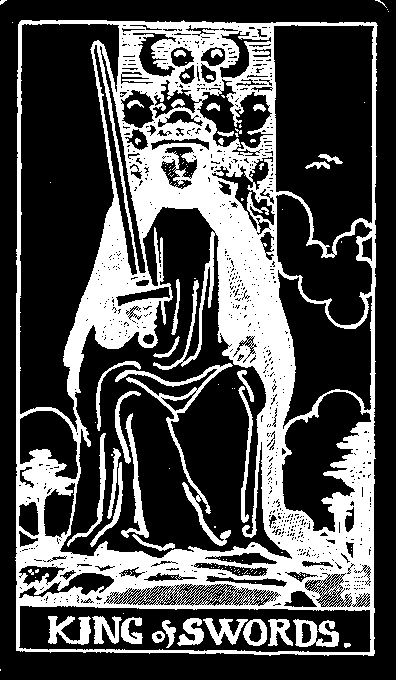
School plate after the 1909 deck (public domain)
Minor arcana · null
King of Swords
judgment · law of mind · the seated verdict
- Element
- Air
The upright blade held still: intellect as office — deciding, and owning its decisions.
The Plate
He is the only sword court who faces you. The page glances aside, the knight charges past, the queen sits in profile; the king looks straight out of the plate, and his sword gives the game away — upright but tilted just off vertical, a judgment with a declared lean. Butterflies and crescents are carved into the throne at his back, two birds hang together in the sky, and the trees behind him stand nearly straight: around this figure alone, the suit's perpetual wind drops to a breeze. Waite (1911) sits him in judgment outright, and hears behind the figure the older Justice of the trumps.
The Reading
The king governs the element the others learned, rode, and kept. Governed Air is thought made public and durable — the rule written where all can read it, the decision issued with its reasons attached, the severance performed once, cleanly, on the record, rather than threatened forever. The school's favorite honesty in the plate is the tilt of the blade. No verdict comes from perfectly nowhere; a judge who admits the lean can correct for it, and the pretense of a perfectly vertical sword is how bad rulings dress. The frontal gaze is the other half of the office: he can be looked back at. Accountability is drawn in, not implied.
Reversed, the card splits along its two failures. Tilt concealed: the office serving an interest and calling it logic. Or the throne vacated in place — the authority who reviews forever and rules never, which in the suit of severance is its own quiet cruelty.
In the School
Last of the courts of Air in the astrology course's elements table: the page learns the element, the knight rides it, the queen keeps it, the king governs it. Governance closes the suit — thought answerable, severance under law.
UPRIGHT
Intellect as office: the standing rule, the verdict owned and signed. Decide — and let the decision be one others can read and check.
REVERSED
The office abused or abdicated — judgment bent by interest, rulings without mercy, or the authority who will not rule at all.
Learn the cards as one system, not seventy-eight fortunes.