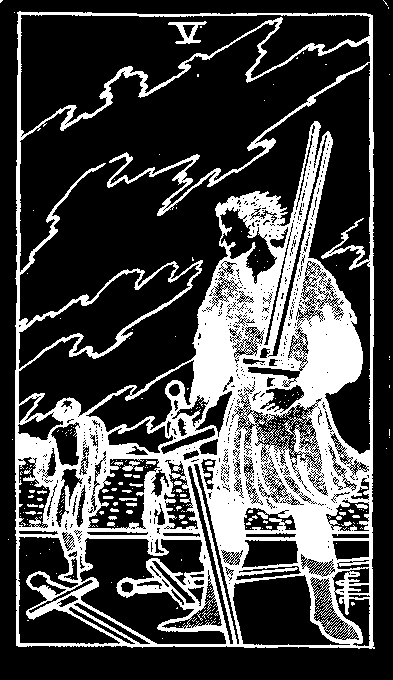
School plate after the 1909 deck (public domain)
Minor arcana · null
Five of Swords
hollow victory · the cost of winning · departure of the beaten
- Element
- Air
The winner collecting swords while the beaten walk away: a victory priced in relationships.
The Plate
He is smiling, and the sky is torn. The clouds over the Five of Swords are drawn like rips in cloth, jagged and horizontal, and beneath them the man in the foreground gathers more swords than he can gracefully hold — two over the left shoulder, a third in his hand, two more still lying at his feet. Down by the water two figures walk away, one with face in hands, their swords among the ones he is collecting. Waite (1911) names the foreground man the master in possession of the field, and the phrase is exact if you weigh it: he possesses the field. Nothing else in the picture is his.
The Reading
The school reads the Five as the cut that severed more than it meant to. Air wins arguments; this card audits the winnings. Every sword on the plate has changed hands, which is to say the victor now carries the whole weaponry of the quarrel himself — the beaten walked away lighter than he stands. The card does not say the fight was wrong. Some fields must be taken. It says the taking has a ledger, and the two departing backs are the entries most readers skip.
Reversed, the plate turns toward what happens after the smirk fades: returning to the shore to give a sword back, or staying to guard an empty beach. The school asks one blunt question of either — whether the win could survive being described aloud to the losers.
In the School
Fifth of the suit of Air in the astrology course's table of elements. Thought severs, and the Five shows severance succeeding socially — the suit's power working exactly as designed, on people who were not designs.
UPRIGHT
Winning at a price the picture is honest about: the field is yours and the company is gone. Ask what the victory was for.
REVERSED
The aftermath — the walk back to the field, the apology or the polished grudge, the slow accounting of what the argument actually bought.
Learn the cards as one system, not seventy-eight fortunes.