tarot spreads
The Three-Card Spread, Done Properly
By Jonah Petrie · Table Practice — July 14, 2026
Shuffle. Cut once. Lay three cards left to right. That is the whole apparatus, and it is enough to keep you busy for a year.
The three-card spread gets treated as the beginner's spread, the thing you do until you have earned the Celtic Cross. Wrong way around. Arthur Waite gave the Celtic Cross two pages of The Pictorial Key to the Tarot (1911) and most people rush to it because ten cards feel like ten times the insight. They are ten times the noise. Three positions, read with discipline, teach you the craft. Ten positions, read loosely, teach you to freestyle. Learn the small spread properly first.
The positions, and what they are not
Past — Present — Future. Simple labels, commonly misread.
- Past is not "everything that ever happened to you." It is the pressure behind the question — what is already in motion.
- Present is not "your personality." It is the situation as it stands tonight, no more.
- Future is not a verdict. It is where the current is heading if nothing changes. Cards read momentum. You steer.
Read the three as one sentence with a beginning, a middle, and a direction. Not three separate fortunes.
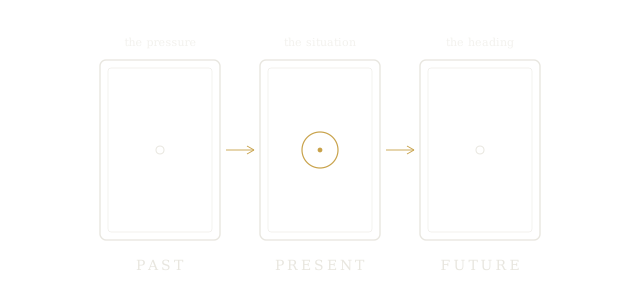 Three positions, one sentence: pressure, situation, direction.
Before you draw
Write the question down. On paper, before you touch the deck. A question you won't write down is a question you are hoping to keep vague, and a vague question makes every card true and every reading worthless.
Bad: "What about my job?" Better: "What should I understand about the decision I have to give my manager by Friday?" The card count didn't change. The reading just became checkable.
A worked example
Say the question is the Friday decision, and the middle card is the Six of Swords — the ferry, the bundled swords, the passengers facing away.
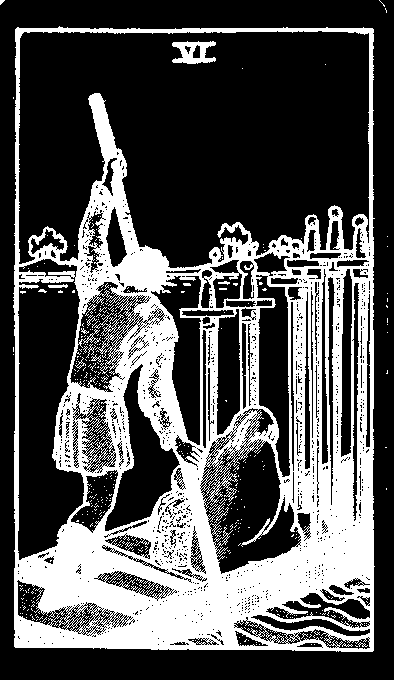 The Six of Swords: a crossing in progress, baggage aboard, the far bank not yet visible.
Look at the plate before you reach for a book. Someone is being carried. The water on the rowing side is rough; on the arriving side, smooth. The swords travel with the passengers — whatever cut, comes along. As the present position, the picture says: you are already mid-crossing on this decision, and pretending you are still on the near shore is the real fiction. Now the past card tells you what pushed the boat out, and the future card tells you what the far bank looks like at the current heading.
That is a reading. No keywords were harmed.
The spread does not know your future. It knows your question better than you were willing to phrase it.
The rules of the table
- One spread per question. Re-drawing until you like the answer is not divination; it is shopping.
- Speak the sentence aloud before consulting any book. Picture first, dictionary second — the meaning you can point at in the image is the one you will remember.
- Write the three cards and one line of reading in your journal. Dated. The journal is the whole discipline: in a month you will see which readings held and which were wishes wearing a costume.
- Reversals are optional. Decide before you shuffle, not after you see the card. Changing rules mid-reading is the fastest way to teach yourself dishonesty.
- Stop at three. If the sentence feels incomplete, the question was incomplete. Fix the question tomorrow. Do not add cards tonight.
Tonight
Take the deck. Write one real question — one with a date or a name in it. Lay three cards. Say the sentence. Write four lines in the journal and go to bed.
Do that ten times over two weeks and you will have learned more than a shelf of card dictionaries can teach, because you will have caught your own readings being right and being wrong — and the difference between those two is the entire craft.
Members lay spreads with the school deck and keep the journal on Melesterion — the daily card is free with an account.
Table Practice
Jonah Petrie
Jonah writes about the practice itself: spreads, the reading journal, the daily card as a discipline rather than a fortune. His rule for the column is that every piece must end with something you can do at a table tonight.