transits
Your First Saturn Return, With Dates Instead of Dread
By Vera Lindqvist · The Working Sky — July 14, 2026
Saturn takes 29.46 years to circle the zodiac. That is the entire mystique of the Saturn return, stated as an orbital period: somewhere between your 28th and 30th birthdays, the slowest of the classical planets arrives back at the degree it held when you were born. The internet has built a small industry of dread around this fact. This column deals in dates and degrees, so let us replace the dread with a calendar.
What actually happens, and when
Find Saturn's position in your birth chart — sign, degree, minute. (Your free chart on this site lists it in the placements table.) The return is exact when transiting Saturn reaches that degree again.
Three things worth knowing about the timing, none of which the dread-merchants mention:
- It is rarely a single day. Saturn retrogrades. In a typical return year the planet crosses your natal degree, backs over it in retrograde, then crosses a third time in direct motion — three exact passes spread across nine to twelve months. Some returns are a single clean pass. The ephemeris, not a feeling, tells you which kind you get.
- The window is narrow by transit standards. Within roughly two degrees of exactness is where the pressure concentrates. Saturn covers about a degree in a week or two of direct motion, so the serious months announce themselves well in advance — you can put your Saturn return in a diary, which already makes it less frightening than most things in a life.
- Everyone in your birth-year cohort shares the season, not the date. Saturn spends about two and a half years in a sign, so your classmates return within the same stretch — but the exact degree is yours.
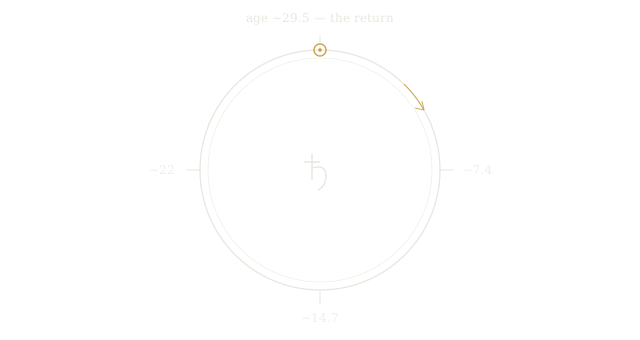 One Saturn circuit: the return at ~29.5, and the quarter-marks at ~7, ~15 and ~22 where the same account is opened, reviewed, and audited in miniature.
What Saturn is, before what it means
The old texts are blunt about this planet and there is no reason to launder them. William Lilly, in Christian Astrology (1647), gives Saturn the cold, dry, heavy register: the planet of limits, labor, walls, debts, time itself. Modern astrology, reaching for kindness, sometimes rebrands this as "the great teacher," which is true but toothless. Here is the working definition this column uses: Saturn is the audit. It does not create your obligations; it presents the invoice for the ones you already carry.
Now apply that to the return. At 29, Saturn has completed one full circuit of every house in your chart — every arena of the life has been visited once, weighed once. The return is the moment the ledger closes on the first draft of adulthood. What survives the audit — the work that was real, the ties that were honest — consolidates, and typically improves. What was borrowed scaffolding gets taken down, sometimes gently, sometimes not.
The Saturn return does not ask whether you are happy. It asks what, of everything you have built, is actually yours — and it keeps only that.
Reading your own, by the numbers
Do this with a chart in front of you, not a horoscope column:
- The house holds the theater. Natal Saturn in the tenth house makes the audit vocational; in the seventh, relational; in the fourth, domestic — the return concentrates there, whatever else is happening.
- The natal aspects hold the plot. Saturn square the Sun natally means the return re-poses a lifelong question about authority and self-direction, now with a deadline. The tight aspects to natal Saturn are the clauses under review.
- The dates hold the schedule. Write down the three exact passes. The first pass usually names the issue; the retrograde pass renegotiates it; the final pass files the settlement. Plan the year's demands around that rhythm and you are working with the clock instead of being surprised by it three times.
And the second return, at ~58–59, runs the same audit on the second draft — by all accounts a fairer examiner, grading work that has had thirty more years to become real. Saturn pays honest work compound interest; it forecloses only on pretense.
Cast the chart, find the degree, mark the calendar. Dread is what the return looks like without an ephemeris.
Your natal Saturn — sign, house, degree — is in your free chart on Melesterion; the transit report tracks the passes for the year ahead.
The Working Sky
Vera Lindqvist
Vera writes about the sky as it moves: transits, returns, timing. Her columns carry dates and degrees, not moods — if a claim can't be pinned to the ephemeris, it doesn't run.