corpus hermeticum
Poimandres: The First Vision in the Corpus Hermeticum
By Ione Kasparian · The Mead Translations — July 14, 2026
Begin where the Corpus itself begins — with a man on the edge of sleep.
The first treatise of the Corpus Hermeticum opens with its narrator in that state the old writers knew well and we have mostly stopped noticing: the body heavy, the senses reined in, the mind unusually light. Into that stillness comes a presence of vast size that asks the only question a teacher ever really asks. In G. R. S. Mead's 1906 translation — the version this column reads, faithful to a fault and Victorian to the bone — the exchange runs:
"What wouldst thou hear and see, and what hast thou in mind to learn and know?"
The narrator answers: he would learn the things that are, their nature, and God. Note the order of that syllabus — things, nature, God — because the vision that follows honors it exactly.
Who speaks
The presence names itself Poimandres. Mead renders the name "Man-Shepherd" — the shepherd of men — and identifies the speaker as Mind itself, the sovereign intelligence, presenting itself to a single human attention that finally sat still long enough to be addressed. Later scholarship has quarreled with Mead's etymology — the name may be Egyptian in origin, not Greek — and the quarrel is worth a footnote precisely because it changes nothing in the text: whatever the name's passport says, the office is the same. Mind comes to mind. The teacher was never far; the student was never quiet.
The date matters too, so let us have it plainly: these treatises were composed in Greek, in Egypt, in roughly the first three centuries of our era — the same Alexandrian world that produced so much else. The Renaissance believed them older than Moses; the scholar Isaac Casaubon dated them honestly in 1614, and the tradition survived the correction, as honest traditions do.
The vision of light
Then comes the seeing, and it is worth slowing down for. All things open into a vast light, serene and joyous — light first, before any world. Only afterward, within it and by contrast against it, appears a darkness, coiling downward, moist, disturbed — the raw stuff from which a cosmos can be organized.
 The sequence of the vision: light first; darkness after, within it — never the reverse.
Sit with the order of operations. In this cosmology light is not a candle carved out of an original night; the dark is a local event inside an original light. And then the third act: out of the light, a holy Word — Logos — descends onto the moist nature and begins to sort it: fire up, air following, earth and water below, the elements separated the way a sentence separates a thought from a murmur. When the narrator asks what the light was, Poimandres answers — and here Mead's line deserves quoting whole:
"That Light am I, thy God, Mind... and the Light-Word that came forth from Mind is Son of God."
Speech that orders chaos, proceeding from Mind, called the Son — written by a pagan hand in Greek Egypt. A reader who knows the opening of John's Gospel will feel the floor tilt; the two texts are neighbors in time and city, drawing on a shared vocabulary, and the scholarly argument about who echoes whom has run for four centuries without a verdict. This column takes no side. It only notes — as the manuscripts do — that two traditions, in the same century, both chose "Word" as the name for what turns chaos into world.
Why this is lesson one
Because the treatise is not reporting news about the sky. It is a diagram of any act of understanding. Every time comprehension happens — every time your confusion resolves into an ordered account — the sequence of the vision replays in miniature: an attention grows still; a light in which things simply are; then the word arrives and articulates. Understanding is a small cosmogony, and you perform one every time a thing becomes clear. The Hermetic claim is that the large version and the small version are the same event at two scales — which is why this treatise stands first in the Corpus, as the door the other seventeen open from.
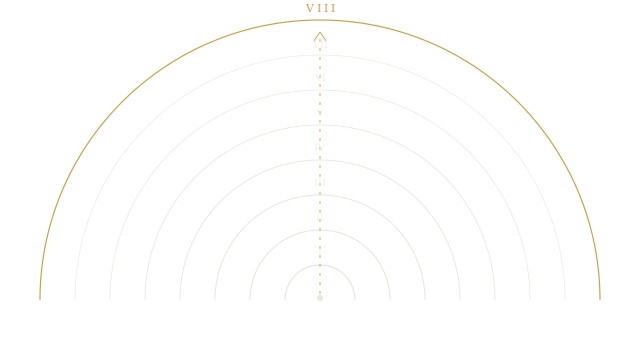 Where the treatise goes next: the soul's ascent through the seven spheres to the eighth — matter for a later letter.
The rest of the vision — the descent of the human into form, and the famous ascent back through the seven planetary spheres, shedding a garment at each — deserves its own column, and will get one.
The Corpus is read in sequence, Mead's text against modern notes, in the Royal Path's hermetic degrees.
The Mead Translations
Ione Kasparian
Ione reads the Corpus Hermeticum through G.R.S. Mead's 1906 translation, a passage at a time — quoting first, glossing after, and marking where Mead's Victorian English needs a modern hand.