mirror hours
20:20 Mirror Hour — What It Means, Without the Hype
By June Halloran · First Houses — July 9, 2026
The dishes are done, the kitchen light is off, and as you carry your tea out of the room you check your phone: 20:20. You checked it last night at the same minute, and — you are fairly sure — the night before that. If this has happened often enough to bother you, you are in numerous company: enough company that "mirror hours" have grown into a small folklore of their own, with dictionaries assigning a guardian and a message to every doubled minute of the day.
Before you accept an assigned message, it is worth knowing what is actually happening — and what the older traditions would and would not say about it. They said less than the dictionaries do. What they said is better.
What a mirror hour is, and how new it is
A mirror hour is a moment when the display doubles itself — 11:11, 13:31, 20:20. Be honest about the machinery first: digital clocks created the phenomenon. Until glowing digits reached the world's nightstands in the 1970s, nobody's evening contained the figure "20:20" at all; you will search the medieval sources for mirror hours in vain.
What the older world did have was the conviction underneath the folklore — that repetition is a knock. A medieval town was governed by exactly this principle, out loud: the bell rang the hours, and rang the watch, and a monastery's whole night was ordered by it — the community rose in darkness for vigils because the bell insisted, again, at the same hour, every night. When a pattern repeats, attention is being requested. That conviction is a thousand years older than your phone; only the clock face is new.
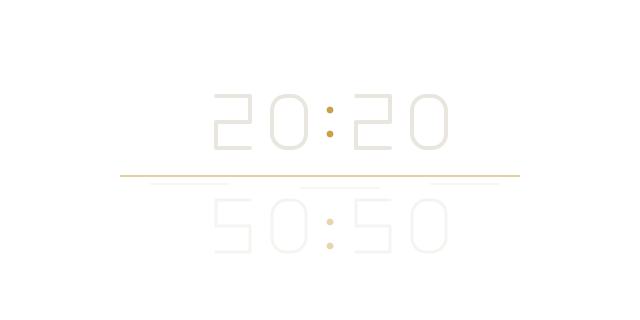 The display doubles itself: the evening's number and its reflection.
Why you — and why the evening
Now the unglamorous mechanism, which deserves one honest paragraph. You glance at clocks dozens of times a day; the sightings that rhyme are the ones memory keeps, and the dozens that don't rhyme are quietly dropped. Psychologists call it selective attention.
But push one step further, because there is a real finding hiding in it. William James, in The Principles of Psychology (1890), called habit "the enormous fly-wheel of society" — the mass of repeated action that keeps a life turning the same way daily. Your evening has a shape, and the shape is habit's work: by 20:20 the day's last obligation is usually behind you and the night's first freedom hasn't begun. At that seam, the mind lifts its head and looks around — and finds the clock. You are not seeing 20:20 by chance; you are surfacing at 20:20 by habit. The clock did not choose you. Your evening did. That is a genuinely useful thing to know about yourself, and no dictionary of hours can tell it to you.
Two, the number of the mirror
So much for the mechanism; now the symbol, taken on the tradition's own terms.
In the number symbolism the West actually used — Westcott's Numbers (1890) collects the sources — two is the dyad: the number of the other. One, alone, cannot be met, mirrored, opposed or loved; the moment a second exists, there is relation, and with relation comes every question the evening tends to raise. The mirror is the dyad's oldest image.
And the oldest mirror story in the Western canon is a warning about misreading one. Ovid, in the Metamorphoses, has Narcissus kneel at the pool and fall for the face in the water — his error was not vanity, exactly; it was taking his own reflection for somebody else. The pool showed him himself, and he read it as another person. Every mirror since has offered the same test.
A doubled twenty, mirrored again across the colon, is the dyad compounded — relation, reflected. A traditional reader would take the theme to be how you are met, and how you meet: the ledger of the day's encounters, presented at the hour when the day's encounters are over.
The mirror hour will not tell you who is thinking of you tonight. It asks a harder question: who were you thinking of when you looked up?
A sober practice for 20:20 specifically
The monasteries, again, were there first. The old end-of-day review — practiced in some form from the Stoics to the cloisters — asked three plain questions at nightfall: what did I do, what did I leave undone, what moved me. Not confession, at this stage; inventory.
Borrow it, at the minute your own attention has already chosen. For one week, when 20:20 catches your eye, write three lines: what you were doing, whom you had been thinking of, and what you were hoping the rest of the evening held. Sunday, read the page. The entries will rhyme — they nearly always do — and the rhyme will name the relation your evenings actually orbit, which is rarely the one you would have guessed on Monday. The pattern was in you, not in the clock — which is far better news, because you are the one thing in this story you can do something about.
 What the old world knew and the new clocks repeat: a knock, to mean anything, must be answered.
That habit of disciplined noticing — attention caught, then turned back on its owner — is the actual doorway into the symbolic arts, and it is where serious study begins.
Ready to study the real system behind the symbols, in order? Degree I of the Royal Path is free with an account.
First Houses
June Halloran
June writes for the reader's first year: signs, houses, aspects, and how to look at a chart without drowning. She keeps a standing promise — no jargon without a plain-English sentence beside it.