mirror hours
11:11 — What the Most Famous Mirror Hour Actually Means
By June Halloran · First Houses — July 9, 2026
You are waiting for the kettle, phone in hand, and the lock screen says 11:11. Again. Third time this week — often enough that you finally typed the number into a search bar, which is probably how you arrived here. Welcome. Hold the wish for a minute; the hour is more interesting than the folklore that has grown over it.
Of all the mirror hours, 11:11 is the celebrity. People who notice no other repeated time notice this one. Schoolchildren were wishing on it long before phones existed — the custom shows up in twentieth-century playgrounds and autograph books, wherever a clock with digits was in view. As with every entry in this series, we will take the hour seriously precisely by refusing to take it cheaply.
The mechanism, honestly
Start with what a psychologist would say, because the old masters would have agreed with him. William James, in The Principles of Psychology (1890), put it in nine words: "My experience is what I agree to attend to." Out of the thousands of impressions crossing you in an hour, the ones that become your day are the ones attention picked up and kept.
Now look at the display itself. 11:11 is the most visually insistent time a digital clock can show — four identical strokes, a little fence of ones. No other minute of the day draws itself with one repeated mark. The eye snags on it the way a sleeve snags on a nail, and memory files the snag. You also glanced at 11:09 and 11:14 this week; you remember neither, because neither rhymes.
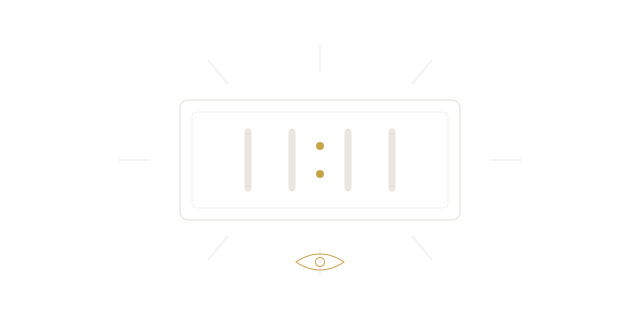 Four identical strokes — the most insistent pattern a digital clock can draw.
You are not being shown the hour; you are catching yourself noticing it. And that is not a debunking. It relocates the event. The question stops being "why does the universe keep showing me 11:11" and becomes "what in me is standing at attention at that moment?" — a question with real, findable answers. James would call it attention; the old schools called it the soul answering a knock. Both are describing the same minute of your day.
Eleven in the old books
The number itself has a longer file than the wishing custom suggests, and the file is stranger than you would guess.
In traditional symbolism, ten closes a cycle. It is the complete decade, the counted fingers; the Pythagoreans drew it as the tetractys — the triangle of 1 + 2 + 3 + 4 — and treated it as the number of the finished world. W. W. Westcott, whose Numbers: Their Occult Power and Mystic Virtues (1890) is still the handiest collection of what the old writers actually said, gathers the whole tradition on this point: ten is the circle drawn shut.
Eleven, then, steps past the closed circle. And here the tradition splits in a way modern folklore has quietly forgotten. Cornelius Agrippa, in the Three Books of Occult Philosophy (1533), files eleven under trespass — the step beyond the law of ten, the number of those who exceed the measure. Medieval bookkeeping, blunt as a ledger. The wishing custom of our own century flipped the sign entirely: gateway, invitation, "angel number." Sinner's number to angel's number in four hundred years.
Notice, though, what both readings agree on — the geometry. Eleven stands outside the finished count, on the far side of a completed thing. One tradition says you have overstepped; the other says you are being let through. Either way you are at an edge. Doubled into 11:11, a traditional reader would hear the theme said four times over — a threshold, insisted upon.
A threshold never tells you what stands on the other side. It tells you only that you have stopped walking, and that you are facing a door.
One, doubled and doubled again
There is a second thread in the number, older than the ledger of sins. Before eleven is "ten plus one," the display is simply the numeral 1 written four times — and one is the monad, the unit before counting begins, drawn since antiquity as a point inside a circle. Westcott opens his whole book with it: everything counted is made of it, and it is made of nothing prior.
The ancients could read a single sign with a straight face. Plutarch — priest at Delphi around 100 CE — wrote an entire essay on the lone letter E fixed at the temple door, weighing guess after guess about what one carved character addressed to the god might mean. His best candidate: it says "Thou art." One mark, read as a sentence about being. Set beside that, spending a page on four ones in a row is restraint.
 Four ones as the pillars of a single gate: unity, insisted upon.
Four units in a row, then, is unity refusing to be scrolled past. Not a message about something else — the something else is you, mid-morning, being asked to be one person for a moment instead of six half-persons juggling tabs.
A practice that costs one week
Wishes cost nothing and teach nothing. Here is the observant version, and it asks for seven days.
Each time 11:11 catches your eye this week, write three lines before you do anything else:
- what you were doing,
- what you were avoiding,
- the first worry or hope that surfaced when the pattern interrupted you.
That is all. Tuesday's entry might read: answering an email I had put off; avoiding calling my mother; money. Thursday's: scrolling; avoiding the same call; money again. No interpretation during the week — the discipline is in the plainness.
Then read the page on Sunday. Almost everyone finds the same one or two threads running through every entry, visible only in the aggregate. The thread is the message. The clock was only the knock.
The old schools had a name for this move — attention, caught by a pattern, turned deliberately back on its owner. They called it the beginning of the Work, and they put it before the study of any symbol, because a student who cannot watch their own noticing will misread every omen they meet. Degree I starts exactly there.
The system behind the symbols can be studied properly, in order — Degree I of the Royal Path is free with an account.
First Houses
June Halloran
June writes for the reader's first year: signs, houses, aspects, and how to look at a chart without drowning. She keeps a standing promise — no jargon without a plain-English sentence beside it.