astrology basics
How to Read a Birth Chart, in Seven Sober Steps
By June Halloran · First Houses — July 9, 2026
A natal chart looks like a clock face crossed with a spider's web, and most beginners meet it the wrong way: they look up their Sun sign paragraph, then their Moon paragraph, then drown in a heap of unrelated traits — generous but stubborn, sensitive but distant, ambitious but tired. A heap tells you nothing, because everything in it is half true of everyone.
A chart is not a heap. It is a sentence, and it reads in an order. The order is not a house style we invented; it is, with small variations, how working astrologers have proceeded since the handbooks were written. Here it is in seven steps, with the reasons attached — because a rule you can't see the reason for is a rule you'll abandon in a week.
1. Get the frame right
You need a birth date, exact time, and place. Not roughly; exactly, from a birth record if you can get one.
Why the fuss? Because the houses — the chart's twelve life-arenas — are anchored to the horizon, and the horizon moves. The wheel of houses rotates completely every twenty-four hours, which means the time of day changes the chart more than the day itself does: noon and midnight give two different charts for the same date in the same town. This is not a modern scruple. Ptolemy built the Tetrabiblos — the second-century book that organized Western astrology for the next fifteen hundred years — on the configuration of the heavens at the moment in question; and the seventeenth-century masters simply refused to judge without honest data. An astrologer who shrugs at the birth time is telling you something about their method.
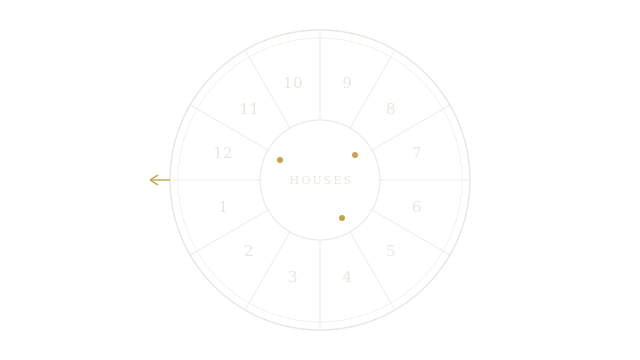 The twelve houses: arenas of life, wheeling fully around once a day. This is why the hour matters.
2. Learn the parts of speech
Four kinds of symbol do all the work. The working grammar, one line each:
- Planets are verbs — recurring functions every life performs: the Sun integrates, the Moon responds, Mercury connects, Venus attracts, Mars asserts, Jupiter expands, Saturn limits.
- Signs are adverbs — the style in which a function behaves. Mars asserts; Mars in Libra asserts diplomatically, and hates itself a little for it.
- Houses are places — the arena of life where the behavior lands: work, marriage, money, the unfinished business of the family.
- Aspects are syntax — the angles that force two functions into one clause: cooperation, friction, a hard stop.
You already speak this language at every family dinner. You have watched somebody's habit overrule their intention, and somebody's drive argue with their fear, all your life. The chart does not ask you to learn new things about people; it asks you to notice that the things you know have grammar.
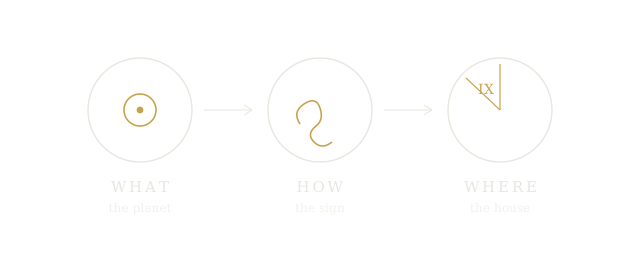 One placement, parsed: what acts, in what manner, on which stage.
3. Read the three pillars first
Sun, Moon, Ascendant — in that order, one plain sentence each, before you touch anything else.
The Sun is the center the life keeps trying to organize itself around. The Moon is what the life does before it thinks — its needs, its reflexes, its three-in-the-morning weather. The Ascendant is the door the world comes in through: the manner, the first impression, the uniform.
Alan Leo — the Edwardian astrologer who did more than anyone to put the Sun at the middle of modern practice — printed a two-word motto on his textbooks, borrowed from Heraclitus: "Character is destiny." That is the claim these three pillars make. State them in three sentences and you have the thesis of the chart; everything after is argument and evidence.
Write the three sentences down. If a reading ever contradicts them without explaining why, the reading is wrong — not the pillars.
4. Weigh, don't list
Before details, take a census. Count the planets by element — fire, earth, air, water — and see where the chart is heavy and where it is empty.
This single weighing explains more than a dozen memorized keyword-traits, because it describes the climate the whole personality operates in. A chart heavy in water and empty of air feels everything and explains nothing — at that same family dinner, this is the person who leaves the table wounded but cannot say by what. Its opposite explains everything and feels late. Neither is a flaw; both are climates, and climates can be dressed for.
5. Take the tightest aspects — only those
Every chart program prints a list of aspects with an orb: the distance, in degrees, from exactness. Here is the rule the old texts enforce and beginners resist: the two or three tightest aspects are biography; the wide ones are background weather.
William Lilly's Christian Astrology (1647) — over eight hundred pages, and the first great astrology manual written in English rather than Latin — is mostly this: rules of judgment, which testimony outweighs which, in what order. His discipline transfers whole: read the tight aspects as standing engagements between two functions. Saturn square Mercury: structure engaging speech — the careful writer, slow to answer, precise forever. One tight aspect, honestly traced, is worth twenty keyword paragraphs.
6. Find the loaded house
Wherever three or more planets cluster, that house is the theater the life keeps renting, season after season. Read it together with the house directly opposite — every stage has a balcony, and the empty house across the wheel is where the audience sits: the tenth-house careerist is answering the fourth house's question about home, whether they know it or not.
7. Say less, trace more
The mark of a real reading — the thing that separates the working astrologer from the fairground tent — is austerity. Fewer claims, each one traceable to a placement you can point at. "You are creative" traces to nothing and means nothing. "You build slowly and hate showing unfinished work — Saturn on the Ascendant" traces, and can be checked against a life.
Anything untraceable is theater. Some theater is beautiful; none of it is astrology.
You can cast your own chart free on Melesterion — exact wheel, placements and aspects — and read it against these seven steps tonight.
First Houses
June Halloran
June writes for the reader's first year: signs, houses, aspects, and how to look at a chart without drowning. She keeps a standing promise — no jargon without a plain-English sentence beside it.