tarot card meanings
The Hierophant, Explained as a System — Not a Fortune
By Claire S. Tilton · The Plates — July 9, 2026
Start with the right hand, because Pamela Colman Smith drew it carefully. It is raised in blessing with two fingers up and two folded down — half of the hand shows, half conceals. That one gesture is the card: some of what this figure knows is being given to you, and some is being withheld until you are ready. Everything else in the picture repeats the point.
The Hierophant is the card readers most often flatten. "Tradition, institutions, conformity" — true as far as it goes, and nearly useless, the way "water is wet" is true. Read from what is actually on the plate, card V is one of the load-bearing images of the whole deck.
What is in the picture
Look at the 1909 image and inventory it. A seated figure between two grey pillars — grey, note, not the black and white pair behind the High Priestess; this is a hall where opposites have been weathered into one institution. A triple crown above; a triple-barred staff in the left hand; two crossed keys at his feet; and below him, backs to us, two tonsured ministers — one robed in roses, one in lilies. Desire and thought, come to be instructed.
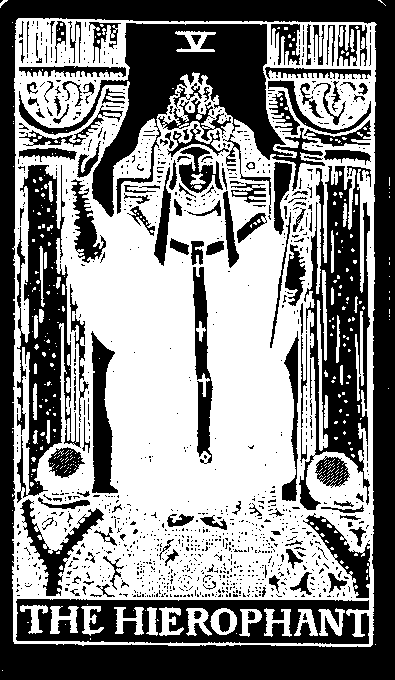 Plate V in the school's white-line treatment: crown, staff, keys, and the two ministers below.
The composition deliberately mirrors the High Priestess, card II. She sits before the veil, silent, the scroll half hidden in her robe. He sits before an assembly, and his mouth is open. Between those two postures lies the card's whole subject: the moment hidden knowledge consents to become teaching — to have a syllabus, a schedule, a hall, and students.
The High Priestess keeps the secret. The Hierophant pays the price of telling it.
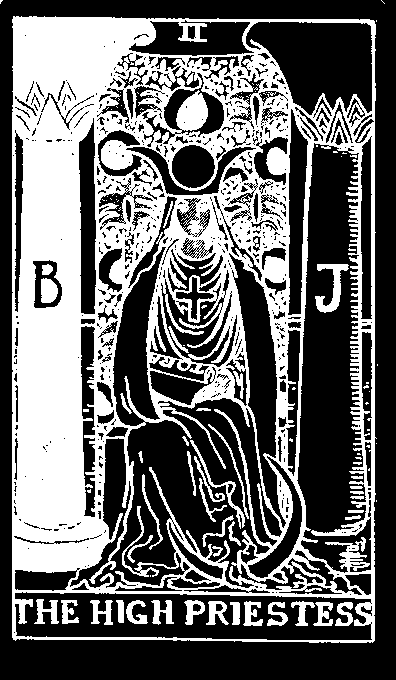 Her plate, card II: the veil, the scroll half hidden, the mouth closed. Set it beside card V and the deck's argument about silence and speech is complete.
The name on the card
For most of the deck's history this card needed no explaining, because it was simply Le Pape — the Pope — as any eighteenth-century Marseille pack will show you, and as Éliphas Lévi, the French magus who died in 1875 and shaped everything the occult revival did with the tarot, was still content to call it.
Arthur Edward Waite changed the name, and the change is a thesis. In The Pictorial Key to the Tarot (1911) he writes that this figure is "the ruling power of external religion, as the High Priestess is the prevailing genius of the esoteric, withdrawn power." External — that is the operative word. And by renaming the card Hierophant, Waite reached past Rome altogether, back to Eleusis.
The hierophantēs — Greek, "the one who shows the sacred" — was not a metaphor. It was an office, held for life, hereditary in a single Athenian family for something close to a thousand years, at the sanctuary whose initiation hall gives this school its name. When the emperor Theodosius closed the pagan sanctuaries by decree in 392 CE, the office ended; within a few years the hall itself was rubble. Here is the detail worth sitting with: the mysteries did not die when belief died — they died when transmission stopped. Someone must turn the ineffable into rite, syllabus and schedule, or what the keepers know goes into the ground with the keepers. The Hierophant is the tarot's image of that someone.
The keys
At his feet, crossed: one key traditionally gold, one silver — sun and moon, in the esoteric reading; the pair that St. Peter carries in a thousand altarpieces, with the power to bind and to loose. A tradition is exactly that pair of powers in one institution. It locks: this is the form, this is the order, you may not skip Degree III. And it unlocks: because the form was kept, a text written seventeen centuries ago is still readable, still teachable, still open.
 One power that opens, one that binds — no tradition survives holding only one of them.
Every serious lineage — monastic, alchemical, martial, musical — has understood that the locking and the opening are the same act performed in two directions. The alchemists compressed it to two words: solve et coagula, dissolve and bind. Card V holds both keys at once, which is why it can never be reduced to "conformity."
Upright and reversed
- Upright, the card is the living chain: find the teacher, join the lineage, accept that structure is the price of inheritance. A lineage, seen coldly, is a technology for surviving the death of its founders — and it works. Nothing else does.
- Reversed, the chain has calcified. Form has outlived meaning; authority quotes itself; the syllabus is mistaken for the sacred; the two fingers folded down have forgotten they were ever holding anything back for someone, rather than from everyone. Most reform movements in history began with somebody reading card V reversed, accurately, inside an institution they loved.
Both faces are in the plate from the start. That raised hand blesses and withholds in the same gesture; whether the withholding is pedagogy or hoarding is precisely what a reading has to decide.
At the table
When the Hierophant arrives in a spread, resist the dictionary. Put the working question instead: what is being transmitted here, and is the channel still alive? The card may be pointing at an institution, a mentor, a family custom, a method you inherited without examining — anything that hands form down a generation. Ask whether the form still carries current. Then ask the harder, second question: in this transmission, are you positioned as a worthy receiver — one of the two figures kneeling in roses and lilies, actually listening — or merely a passive one, present in the hall and absent from the lesson?
The card does not answer. It shows the hall, the chain, the keys — and waits to see which minister you are.
This essay is written in the method of our Tarot Codex — every card taught as one system, image first. The daily card is free with an account.
The Plates
Claire S. Tilton
Claire writes the card-by-card column. She reads each card from what Pamela Colman Smith actually drew — checked line by line against Waite's 1911 Pictorial Key — and distrusts any meaning that can't be found in the picture. She calls herself a student of the images first, a reader second.