tarot correspondences
The Four Suits and the Four Elements: Where the Map Comes From
By Margarethe Voss · Correspondences — July 14, 2026
Every tarot book tells you the four suits map to the four elements. Almost none of them tell you that the sources disagree about how — and the disagreement is the most instructive thing in the whole file. This column keeps the system pages, so let us keep this one properly: what maps to what, who says so, and where the seams show.
The mapping, as this school teaches it
- Wands — Fire. The will, the project, the spark that starts things. The plate to study is the Ace: a living branch, still sprouting, offered out of a cloud.
- Cups — Water. Feeling, relation, what is received and held. The one mapping nobody disputes.
- Swords — Air. Thought, speech, judgment — the edge that divides in order to clarify.
- Pentacles — Earth. Body, work, money, the made and maintained world.
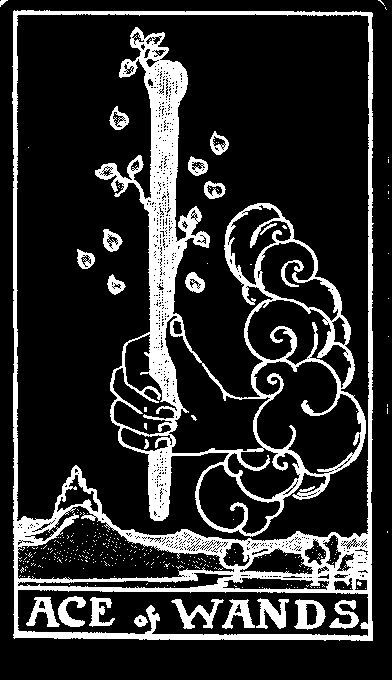 The Ace of Wands: fire as a growing branch — the suit's whole thesis in one image.
Four suits, four elements, four verbs: I will, I feel, I think, I have. You now hold forty of the seventy-eight cards in a rough sketch, because each numbered card is its element passing through a stage. That is the power of a correspondence: it compresses.
Who says so
The mapping above is the Golden Dawn arrangement — worked out in that order's papers in the 1890s, carried into the 1909 deck by Waite and Smith, both members, and spread worldwide by the deck's success. When your phone app tells you Swords are Air, it is quoting a Victorian secret society's homework, at third hand, without the citation.
Reach further back and the ground shifts. Papus — the French physician Gérard Encausse, whose Tarot of the Bohemians (1889) is the great systematizing book of the continental school — builds his suits on the letters of the divine name rather than on the elements directly; the elemental attributions ride on top, and they do not everywhere match the English ones. Éliphas Lévi, earlier still, had his own arrangement. The suit–element map is a teaching, not a discovery — different lineages drew it differently, and each was internally consistent.
The disputed border
The live dispute is Wands and Swords. The Golden Dawn fixed Wands as Fire and Swords as Air, and this school follows them — the deck we study was drawn to that key, and the images cooperate: the wands sprout, the swords cut.
But a respectable continental line runs the other way — swords as fire (the forged blade, the flashing temper), wands or batons as air (the herald's staff, the word carried). If you learn tarot from certain French or Spanish sources, that is the key you will inherit. Neither camp is confused; they are reading different metaphors off the same objects.
A correspondence is not true the way an eclipse is true. It is true the way a map's projection is true: chosen, consistent, and honest about what it distorts.
What matters at the table is declaring your key and holding it — a reader who slides between systems mid-spread is not being eclectic; they are being unfalsifiable.
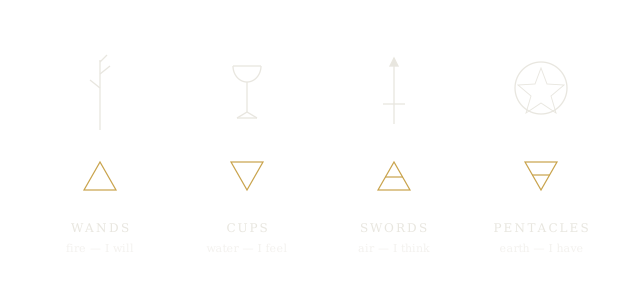 The Golden Dawn key, as this school teaches it: wand to fire, cup to water, sword to air, pentacle to earth.
Why the map earns its keep
Correspondence is what welds the tarot to the rest of the curriculum. The Ace of Cups and the Moon in a birth chart and the alchemists' dissolving bath are not the same thing — but they are all Water saying something, and a student who has learned Water once can hear it in all three dialects. The old teachers prized the tarot precisely for this: seventy-eight cards as a portable index to the whole symbolic system.
Learn the four elements first, in the cards, where they have faces. The rest of the correspondences — planets, signs, the paths — stack on top of this foundation, and we will take them one column at a time.
The full correspondence tables, card by card, live in our Tarot Codex — open to browse with a free account.
Correspondences
Margarethe Voss
Margarethe keeps the system pages: how the seventy-eight cards map to planets, signs and elements, and where those mappings came from. She works from the published sources — Papus, Waite, the Golden Dawn papers — and flags every point where they disagree.