alchemy stages
Calcination: The First Gate of the Work
By Edith Marlowe · The Athanor Letters — July 14, 2026
Dear student,
You asked, in your last letter, where the Work actually begins — not in the diagrams, but on an ordinary Tuesday, in a life like yours. It begins in fire, and I owe you the courtesy of not softening that.
The old masters arranged the Great Work as a sequence of operations, and nearly every arrangement — whatever else it disputes — puts calcination first. George Ripley, the Yorkshire canon whose Compound of Alchymie (1471) laid out the Work as twelve gates, made calcination the first gate a student walks through. In the laboratory the operation is simple to describe: a substance is held in fire until everything volatile is driven off and what remains is ash — dry, mineral, incapable of burning further. The alchemists did this to metals and salts in real furnaces for real centuries. And they said, with unusual unanimity, that the furnace was also a mirror.
The furnace with two chambers
Their instrument was the athanor — the "philosopher's furnace," built to hold a low, even fire for weeks, warming the sealed vessel at its heart. Not a blaze; a patience. The design is the first teaching: the fire that accomplishes anything in this art is regulated fire, tended daily, neither allowed to gutter nor to rage.
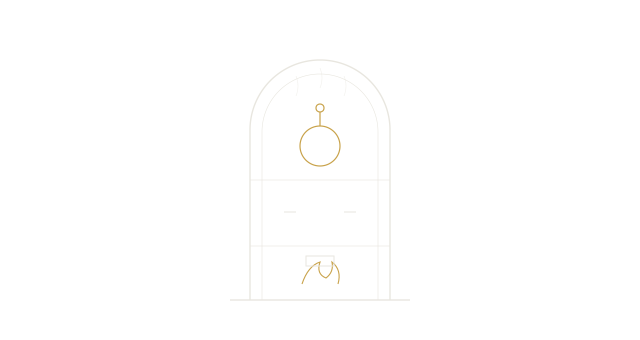 The athanor: a tower built to keep one moderate fire alive for as long as the Work requires.
Read as an inner operation — and this is how this column will always read the Work, matter for the historians, soul for us — calcination is the burning-off of what only appeared to be you. The reputation curated for an audience that was never really watching. The ambition inherited from a parent and never countersigned. The opinions held because your circle holds them, the busyness performed because stillness felt like falling. All of it is volatile matter: it flares brightly and it cannot survive sustained heat.
Life supplies the furnace without being asked — a failure, a loss, an exposure, a year when the applause stops. The tradition's claim is not that these fires are good. It is that they are usable: what fire does anyway, the artist does deliberately.
Calcination does not burn you. It burns what you were carrying and calling by your name.
What the ash is
Do not mistake the ash for a residue of defeat. In the laboratory the calcined body — the caput mortuum, the ashes — was prized precisely because it was fixed: it could no longer be inflated, ignited, or carried off by the draft. Everything that could be taken by fire had been taken. What remained belonged.
The inner equivalent: after a true calcination there are fewer things you need others to believe about you, and the ones that remain are load-bearing. You are smaller and heavier, in the way a foundation is smaller and heavier than a bonfire. The Work does not begin by adding anything; it begins by finding out what is fireproof.
 The caput mortuum: not what the fire destroyed — what the fire could not.
The deliberate version
You do not have to wait for life to light this fire, and the masters did not recommend waiting. The disciplined form is modest and repeatable:
Choose one claim you make about yourself — in conversation, in your own head, on whatever passes for your shop window. Hold it in a steady flame of honest questions for a week. Where is the evidence outside my own account? What would remain of this if nobody ever learned of it? Whom am I performing it for? Write the answers in the evening, briefly, without cruelty and without mercy — the athanor's even heat, not a bonfire of self-accusation. If the claim survives, it is ash in the good sense: fixed, yours, done arguing. If it does not survive — better to learn it in a week's quiet fire than in a decade's public one.
Then choose the next claim. The fire is not the crisis. The fire is the discipline that makes the crisis unnecessary.
Next letter: what the tradition means by dissolution — why the ash must go into the water, and why so many students who survive the fire flinch at the bath.
With a steady flame, E. M.
The alchemical degrees of the Royal Path take the operations in Ripley's order, one gate at a time.
The Athanor Letters
Edith Marlowe
Edith writes the Great Work as an inner discipline — calcination to rubedo as stages a person actually passes through. Each column is a letter to a student partway along, which is how she describes herself.