hermetic principles
As Above, So Below: What the Old Line Actually Claims
By Arthur Pell · The Seven Principles — July 14, 2026
As above, so below. Four words, and most people who say them could not tell you the sentence they were cut from — which is a pity, because the full sentence is doing work the slogan has forgotten.
The line descends from the Emerald Tablet, the short Hermetic text that medieval and Renaissance alchemists treated as the charter of their art. The Latin versions circulated from the twelfth century; the most famous English rendering in existence sits in a manuscript by Isaac Newton — yes, that Newton, who spent more ink on alchemy than on optics — and runs: "That which is below is like that which is above, and that which is above is like that which is below, to do the miracles of one only thing." Note what the slogan drops: the purpose clause. The likeness of above and below is not stated as a curiosity. It is stated as the working condition for an operation.
The Kybalion — the 1908 book through which most modern readers meet the principle — compresses it into its second axiom: "As above, so below; as below, so above." The book is a door, not a house; but this door opens onto the right corridor.
What the claim is not
Start by clearing the rubble. "As above, so below" is not the claim that the universe is a mood board — that a comet means your landlord will relent, or that Mercury's orbit reaches into your inbox and corrupts your attachments. Read that way, the principle becomes unfalsifiable decoration, and the tradition deserves better tenants.
It is also not, in its old form, a claim about physical causation. The alchemist heating a vessel did not think the stars were pumping heat into it. The relation asserted is stranger: pattern, not force.
 One figure, two registers: the claim is likeness of pattern, not transmission of force.
What the claim is
Here is the principle stated so that it can actually be used: reality repeats its structures across scales and registers. The pattern you find in one layer — in the sky's cycles, in a year's seasons, in a life's ages, in a single evening's rise and fall of attention — recurs in the others, because all of them are drafts of one grammar.
The tradition's entire method falls out of this single claim. Why does the astrologer study planetary cycles? Not because Saturn pushes — because Saturn's slow circuit is the visible, datable copy of a pattern that also runs, invisibly and undatably, through a career or a character; you read the legible copy to learn the shape of the illegible one. Why does the alchemist watch matter blacken and whiten in a flask? Because the sequence in the glass rehearses a sequence in the soul, where there is no glass to watch. The visible is the textbook of the invisible. That is the whole of it.
The stars were never the cause. They were the copy you could read at night.
The correspondence runs both directions — as below, so above — which is the half everyone forgets. Study your own habits honestly and you have learned something about the structure of larger things; the microcosm is admissible evidence about the macrocosm. The Renaissance called the human being a little world, microcosmus, for exactly this reason.
The test that keeps it honest
A principle that explains everything explains nothing, so give this one a job with failure conditions. Take one pattern you can verify — the year's descent into winter and climb out of it, say. Now look for that same shape in one bounded place: a project, a friendship, a course of study. Name the phase you are in before checking the outcome, in writing. Sometimes the mapping will illuminate; sometimes it will embarrass you. Keep score. The old writers did not ask for belief; the Tablet says to do the miracles of one only thing — it is a manual cover, and a manual is judged by whether following it produces the result.
Correspondence is a tool for finding your place in a pattern — never an alibi for what you do there.
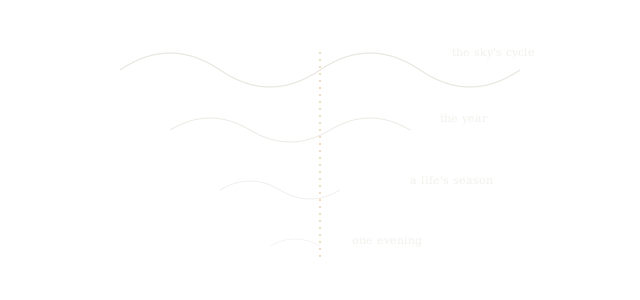 One grammar, many registers: sky, season, life, evening — the ladder the method climbs.
Next in this column: the first principle — Mentalism — and why the Kybalion's most quoted axiom is its most misread.
The seven principles are taught in order, against their sources, in the Royal Path — Degree I is free.
The Seven Principles
Arthur Pell
Arthur writes the Kybalion column, one principle at a time, testing the 1908 text against the older Hermetic sources it claims to summarize. He is fond of saying the book is a door, not a house.